Mugwort - Nature’s Dreamweaver
For this specific herb, we want to give a quick disclaimer to avoid Mugwort especially early on in pregnancy due to it’s effect on the uterus and potentially causing contractions.
If you have any questions or comments you would like to leave us with, as always feel free to contact us.

The Mother of Herbs
Mugwort is often referred to as the Mother of all herbs, having been used throughout history and especially with profound effects in supporting the female body. It grows wild and abundantly throughout Europe and Asia and now North America after being brought over by settlers and its uses are equally abundant. It can be used as an herb directly in food, for topical applications, in acupuncture, teas, as essential oils and more. Here we want to look at Mugwort when extracted as a Tincture.
When properly extracted many of the beautiful constituents of the plant are preserved including some of the essential oils. We want to take a look at some of those compounds and see what they are doing in our bodies.
Altering Dream States
If you’ve read our article on Ashwagandha Root you will have learned that our brain has neurotransmitters called GABA, that make up for around a third of our brain’s signal processing. GABA when activated are like a brake pedal for our excitability, influencing our brain and then nervous system and helping to calm us. Imagine these receptors like little locks that are waiting for the right key. Insert one key and it turns the receptors on so that they produce a calming effect, insert another key and they can be turned off and will no longer inhibit these intense signals.
During REM sleep, when dreams occur, your brainstem begins by sending signals throughout the brain. These signals pass through your visual cortex (creates images in the mind) and limbic system (adds emotions to the experience) among others. The Thujone found in Mugwort then blocks GABA’s inhibitory effects and the perceived experiences are able to become more intense.
Compounds found in the essential oils of Mugwort such as Camphor help to increase blood flow to regions of the brain responsible for memory-processing. Camphor has also been linked to improved recollection of emotional aspects of dreams. α-Pinene and β-Pinene for example are said to improve the hippocampus’ ability to store dreams in your long-term memory.
These are just some of the components found in Mugwort that have an impact on our dream-lives. This is why cultures have historically praised the herb’s spiritual effects such as lucid dreaming, creating vivid “between worlds” states and general spiritual awareness.
Mugwort has been known to help those with restless sleep or unpleasant dreams to have a more peaceful and sound sleep. At the same time it has been said to even help in cases of sleeping without dreaming, so those taking it found themselves dreaming again or at least remembering their dreams.
If you are on one of these journeys trying Mugwort tincture before bed could be beneficial, but also should be coupled with clear intentions in your mind of what you want to achieve while you sleep and other aids such as dream journals will only help in this process as well, as it shows your brain that you are placing importance on these memories.
Mugwort as a Bitter
Mugwort has sesquiterpene lactones and flavonoids which give it the bitter taste and stimulate digestive enzymes and bile production. Bile emulsifies fats in the body which makes it easier to digest and helps prevent cases where fat isn’t absorbed properly. This is why it has been historically taken after a heavier meal, for example as a tea to help digestion and reduce feelings of sluggishness or being bloated.
Female Reproductive Health
Mugwort is a very special herb when it comes to the female body. In essence it adapts to your current needs. When someone has irregular periods, Mugwort can initiate some gentle cramping to get the body back on track. For this reason it has also been used traditionally to induce labor as it can cause cramping of the uterine muscles. However this is also why we advise caution with Mugwort during early stages of pregnancy to avoid unwanted contractions that might lead to miscarriage.
At the same time Mugwort can come alongside already intense contractions and help soothe the muscles and bring relief, making it a staple for those with more intense periods. Some of the compounds in Mugwort also assist the body in stimulating blood flow which is also a vital part in promoting regular menstrual cycles.
Regulating periods along with hormone-regulating compounds found in Mugwort that directly affect ovulation is part of the reason this herb is treasured for supporting fertility as well.
As a very simplified explanation for the chemical processes induced by Mugwort-specific compounds, we have some that regulate the calcium intake of the muscles which directly influences tightening or relaxing, based on higher or lower calcium amounts. Then we have other compounds acting as sedatives in the brain. bringing relaxation to our senses in how we perceive the discomfort caused by the contractions.
Pain and Stress Relief
As we have already covered in the dream and reproductive benefits associated with Mugwort, some of her compounds contain sedative properties, that can assist the body in entering relaxed states. Some of these compounds have been used traditionally for relief from inflammation and also headaches, join-pain and other body aches.
The sedative properties are administered with negligible side-effects of drowsiness making it an easy go-to for calming frazzled nerves at any time of the day.
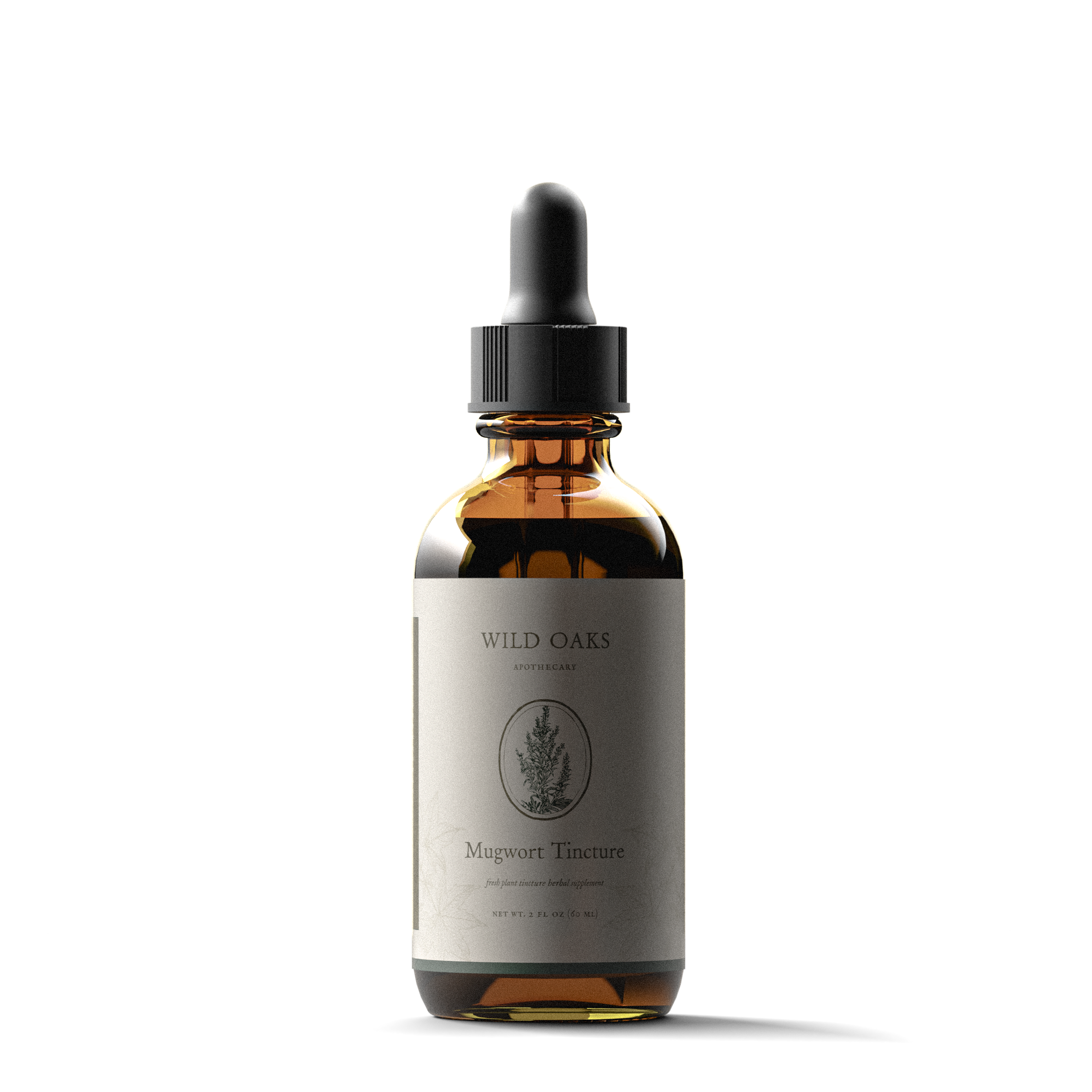
This fragrant plant was traditionally used to help the female reproductive system. It can help to support the menstrual cycle, help to slow excessive menstrual bleeding, warm the womb, and can also help to bring on menstruation if it seems to be delayed for no known reason.
Mugwort is also useful for promoting circulation within the body. It is also a nervine and can be used to help soothe the body. Mugwort can be reached for when needing stomach support, such as help digesting food or help with stomachaches. It can also be used topically in tea or tincture form to help soothe reactions like that caused by poison ivy. Native Americans leaned on mugwort for dream support, as it is said to help to increase vivid dreaming.
A NOTE ABOUT OUR STANDARDS — All of our tinctures and elixirs (except for the mushroom elixirs) are made with 100-proof alcohol (grain alcohol and local spring water) and fresh plant material. For elixirs, they are made with 100-proof alcohol, raw honey, and fresh plant material.
We source fresh plants from California, from farmers who practice organic farming or “beyond organic” farming practices. All herbs are made into extracts within 24 hours of being picked, so they are extra potent!
We use fresh plants to preserve both water- and alcohol-soluble constituents that are lost when the plant is dried. Fresh plants make for a more potent extract and preserve the life force of the plant in the season it was meant to produce in.
Tincture = alcohol + herb
Elixir = alcohol + raw honey + herb